
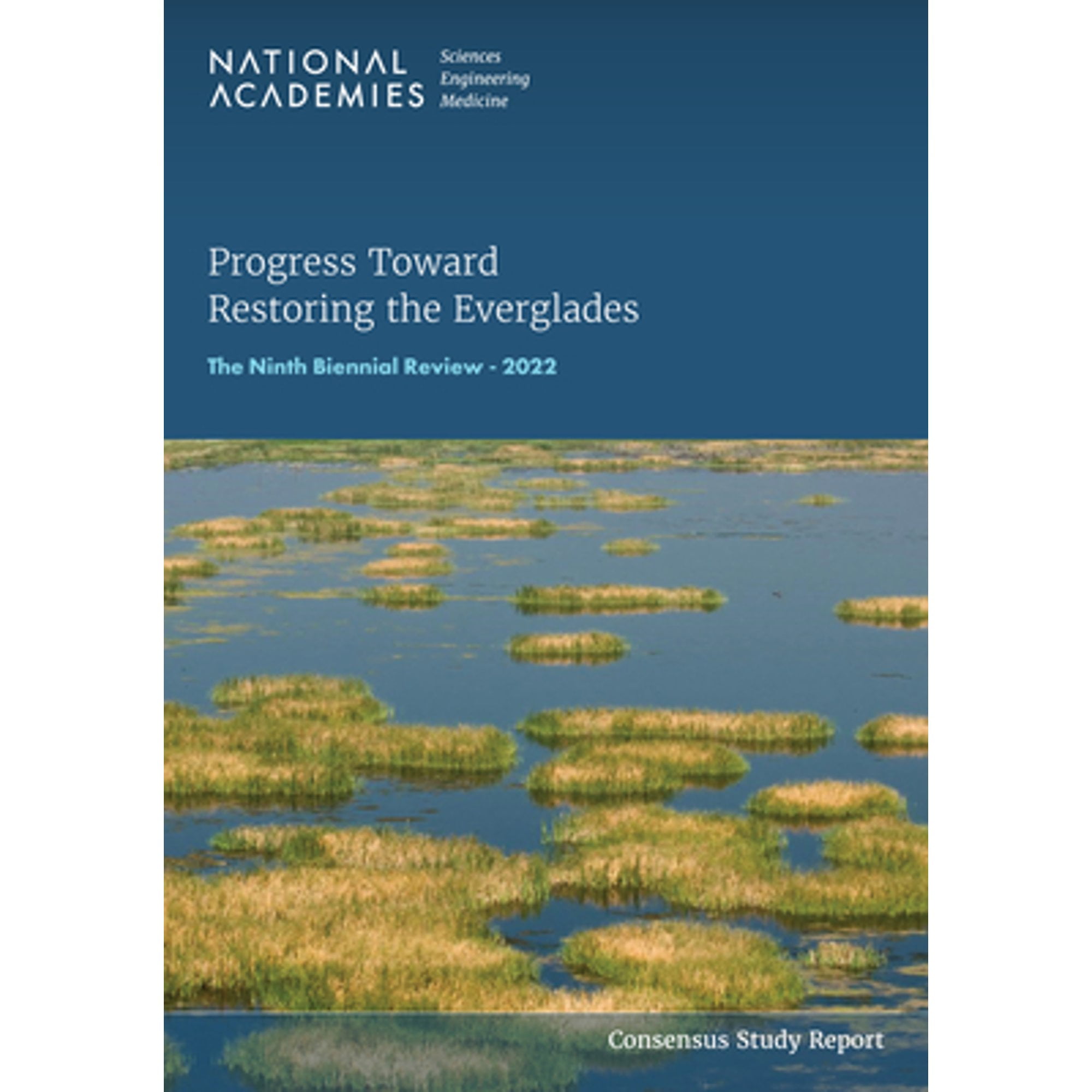
Pre-Owned Progress Toward Restoring the Everglades: The Ninth Biennial Review - 2022 (Paperback) by Engineering National Academies of Sciences, Medicine, Division on Earth and Life Studies, Water Scie
Product details
| Management number | 230498845 | Release Date | 2026/06/18 | List Price | $13.84 | Model Number | 230498845 | ||
|---|---|---|---|---|---|---|---|---|---|
| Category | |||||||||
9780309693431. Pre-owned: Good condition. Paperback. Language: English. Intended for professional and scholarly audience. Over the past century, the Everglades has been dramatically altered by drainage and water management infrastructure intended to improve flood management, urban water supply, and agricultural production. Less than half of the original Everglades remain, and these remnants compete for water with urban and agricultural interests, all the while being impaired by contaminated runoff. The Comprehensive Everglades Restoration Plan (CERP) was established in 2000 as a joint effort by the state and federal government to reverse the decline of the ecosystem. The multibillion project aims to restore the ecosystem over the course of 30 to 40 years by reestablishing the natural hydrological characteristics of the Everglades where feasible and ultimately creating a water system that serves both the natural and human needs of South Florida. Since 2004, a National Academies committee has provided a series of independent, peer-reviewed assessments of CERP progress. Implementation of CERP projects has occurred at a remarkable pace over the past two years due to record funding levels. Ecosystem responses are evident over large areas of the central and western Everglades after implementation of recent restoration initiatives. This progress in implementation has increased the importance of analyzing and synthesizing natural system responses. The committee review of ongoing progress highlights the need for rigorous scientific support for water quality improvement in stormwater treatment areas and modeling for a wider range of plausible climate conditions. Progress Toward Restoring the Everglades: The Ninth Biennial Review - 2022 recommends the development of a multiagency Everglades restoration science plan to ensure the needed tools, research, analysis, and synthesis are available to support critical restoration management decisions. Table of Contents Front Matter Summary 1 Introduction 2 The Restoration Plan in Context 3 Restoration Progress 4 STA Water Quality and CERP Progress 5 Restoration in the Context of Climate Change 6 Science Plan to Support Restoration of the South Florida Ecosystem References Appendix A: The National Academies of Sciences, Engineering, and Medicine Everglades Reports Appendix B: STA Performance Summary Appendix C: Biographical Sketches of Committee Members and Staff
9780309693431. Pre-owned: Good condition. Paperback. Language: English. Intended for professional and scholarly audience. Over the past century, the Everglades has been dramatically altered by drainage and water management infrastructure intended to improve flood management, urban water supply, and agricultural production. Less than half of the original Everglades remain, and these remnants compete for water with urban and agricultural interests, all the while being impaired by contaminated runoff. The Comprehensive Everglades Restoration Plan (CERP) was established in 2000 as a joint effort by the state and federal government to reverse the decline of the ecosystem. The multibillion project aims to restore the ecosystem over the course of 30 to 40 years by reestablishing the natural hydrological characteristics of the Everglades where feasible and ultimately creating a water system that serves both the natural and human needs of South Florida. Since 2004, a National Academies committee has provided a series of independent, peer-reviewed assessments of CERP progress. Implementation of CERP projects has occurred at a remarkable pace over the past two years due to record funding levels. Ecosystem responses are evident over large areas of the central and western Everglades after implementation of recent restoration initiatives. This progress in implementation has increased the importance of analyzing and synthesizing natural system responses. The committee review of ongoing progress highlights the need for rigorous scientific support for water quality improvement in stormwater treatment areas and modeling for a wider range of plausible climate conditions. Progress Toward Restoring the Everglades: The Ninth Biennial Review - 2022 recommends the development of a multiagency Everglades restoration science plan to ensure the needed tools, research, analysis, and synthesis are available to support critical restoration management decisions. Table of Contents Front Matter Summary 1 Introduction 2 The Restoration Plan in Context 3 Restoration Progress 4 STA Water Quality and CERP Progress 5 Restoration in the Context of Climate Change 6 Science Plan to Support Restoration of the South Florida Ecosystem References Appendix A: The National Academies of Sciences, Engineering, and Medicine Everglades Reports Appendix B: STA Performance Summary Appendix C: Biographical Sketches of Committee Members and Staff| Book format | Paperback |
|---|---|
| Publication date | June, 2023 |
| Publisher | National Academies Press |
Bestseller ranking
Logic



Customers who viewed this product also viewed
Pre-Owned Books






Correction of product information
If you notice any omissions or errors in the product information on this page, please use the correction request form below.
Correction Request Form